
What the Mirror Taught Me!
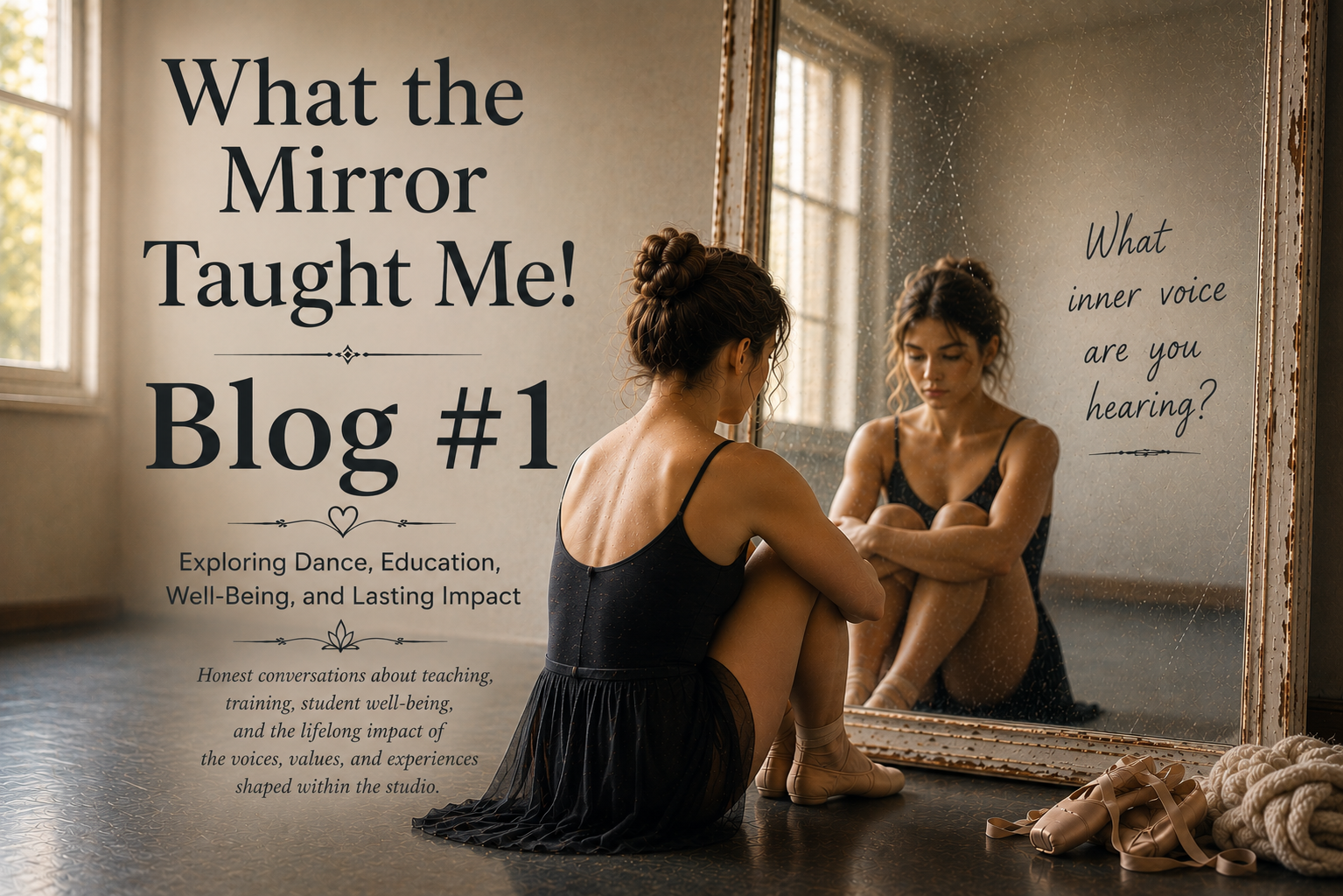
A voice that learned to search for flaws before strengths and problems before possibilities.
A Message to Ballet Teachers and Young Dancers
It is really important to be aware that not everyone who trains in ballet develops long-term difficulties with mirrors or self-image, but for some, the combination of constant mirror use and critical environments (whether these being in the studio, at home or at school), can have lasting psychological effects.
The Lasting Psychological Impact of Mirror Dependence
and Negative Teaching in Ballet Training
In many ballet studios, mirrors are considered an essential training tool and an essential part of the studio inventory. Dancers use them to check alignment, technique, posture, and aesthetics. While mirrors can help develop technical accuracy, an overreliance on them—especially when combined with harsh, critical, or shaming teaching methods—can have significant negative consequences for a dancer's mental well-being that may persist long after training ends.
What the Mirror Taught Me
I grew up believing that the mirror was my teacher. Every ballet class was spent facing my reflection, searching for what was wrong. Was my turnout good enough? Were my arms correct? Was my body thin enough? Was I standing properly? Was I beautiful enough to belong in this world? The mirror was presented as a tool for improvement, but for me it became something else entirely. It became a place where I learned to judge myself.
This is not simply a story about mirrors. It is a story about the inner voice that some dancers develop as a result of years spent standing in front of them. A voice shaped by constant correction, comparison, evaluation, and, at times, negative teaching language. A voice that learned to search for flaws before strengths, problems before possibilities.
Over time, that voice can become so familiar that it feels like part of who we are. Yet it is not necessarily our true voice. It is an internalized critic, formed through repeated experiences in the training environment, that can continue to influence how we see ourselves long after we leave the studio. For teachers, this raises an important question:
What inner voice are we helping to create in the students we teach today?
At the same time, I was exposed to teaching language that focused heavily on flaws, mistakes, and what needed fixing. Some comments were direct. Others were subtle. But the message I absorbed was always the same: I was never quite enough.
As a child, I did not have (nor does any child) the emotional maturity to separate technical corrections from my sense of self-worth. When I heard criticism while looking at my reflection, my brain linked the two together. Looking in the mirror became associated with finding faults. Instead of seeing a person, I learned to see a collection of problems to solve.
Internalizing critical voices is often our attempt to fit in, belong, and succeed within the environment around us. If we learn that criticism is the only path to improvement, we can begin to treat ourselves in the same way.
What many people do not understand is that these lessons
do not necessarily stay in the ballet studio.
Years later, long after classes ended, I found myself standing in front of mirrors still hearing those voices. I could no longer remember every teacher or every comment, but I remembered the feeling. I remembered automatically scanning myself for imperfections and measuring myself against impossible standards. Over time, those external voices became internalized. What had once come from teachers, corrections, and expectations gradually transformed into an inner critic that accompanied me everywhere. Even when nobody else was judging me, that voice continued to search for flaws, weaknesses, and areas that needed fixing.
When I looked in a mirror, it was often this inner critic that spoke first. It encouraged me to focus on what was wrong rather than what was right. It interpreted my reflection through a lens of judgment, comparison, and inadequacy. The studio may have been gone, but the habits of thinking it helped create remained.
These effects can extend beyond dance. Negative mirror experiences may contribute to low self-esteem, body dissatisfaction, perfectionism, anxiety, and difficulties with self-compassion. Some individuals report feeling unable to look at themselves without immediately identifying something "wrong." Others may continue to compare themselves to unrealistic standards long after leaving the ballet world.
The issue is not the mirror itself, but the environment in which it is used.
Mirrors can support learning when they are paired with healthy teaching practices that emphasize body awareness, curiosity, progress, and respect. Similarly, constructive feedback can help students improve without damaging their self-worth. Problems arise when mirrors become instruments of constant judgment and when teachers rely on criticism, humiliation, or fear to motivate students.
Creating healthier ballet environments requires recognizing that technical excellence and psychological well-being are not mutually exclusive. Dancers thrive when they receive feedback that is specific, supportive, and focused on skill development rather than personal inadequacy. By fostering self-awareness instead of self-criticism, educators can help students develop both strong technique and a healthy relationship with themselves.
Even today, that inner critic is still present.
When I look in the mirror, it is often the first voice I hear. It quickly points out perceived flaws, shortcomings, or things that could be better. Sometimes I find myself searching for imperfections before I have even consciously looked at my reflection. Other times, I avoid mirrors altogether because I do not want to engage with the criticism that may follow.
What makes this especially difficult is that the people around me often do not see it. They tell me I look well, I look good. They tell me I have no reason to be so hard on myself. They see someone who is happy, positive, and full of joy. Yet the inner critic is not easily silenced by reassurance. It was built over years of repetition, and its messages can feel far more familiar than the compliments offered by others.
The Voice I Thought Was Mine!
Over time and through therapy, I have come to understand that these thoughts are not simply "me." They are the voice of an internalized critic that was shaped by years of training, correction, comparison, and evaluation. What began as external messages gradually became an internal dialogue. The studio mirrors and dance educators from the past may have disappeared from my daily life, but the voice it helped create remained.
Many teachers care deeply about the well-being of their students and recognize that the lessons learned in the studio extend far beyond technique. My hope is simply to encourage continued reflection on the lasting impact our words, actions, and teaching environments can have.
The Lasting Influence of Teaching!
That is why I believe this conversation is so important. Teachers may never know which comments will be remembered and which will be forgotten. They may never see the long-term impact of the environments they create. Yet every day, they are helping to shape the inner voices that students carry with them into adulthood.
Only now am I beginning to consider the possibility that one day I might look in a mirror and see something positive before I see something wrong. For many people, that may sound insignificant. For those of us who learned to see ourselves through constant correction and criticism, it can feel like a remarkable and hopeful step.
Beyond the Mirror! Reflection
My hope is that future generations of dancers will learn that lesson much earlier than I did. That they will be taught to use mirrors as tools rather than judges, corrections as guidance rather than measures of worth, and that they will leave the studio carrying an inner voice that encourages growth without sacrificing self-compassion.
Reflective questions
Students:
When you look in the mirror, whose voice do you hear—and is it helping you grow, or teaching you that you are never enough?
Parents:
What inner voice is your child developing through their dance training, and is it one you would want them to carry into adulthood?
Teachers:
When your students leave your studio, what inner voice will they carry with them?
Today's students are tomorrow's teachers, leaders, and role models. As educators, parents, and mentors, we have a responsibility to ensure that the inner voices they carry forward are rooted in growth, self-respect, and possibility rather than criticism and self-doubt. Every individual deserves the opportunity to grow in an environment that respects their unique strengths, personality, potential, and humanity.